What Your Movement Reveals When You Actually Measure It
Every provider has watched you walk across the room and said something. Kinetisense replaces that clinical impression with scored, time-stamped, objective data — so your movement health is measured, not guessed.
Sample output — your score in 0–100 range, benchmarked to age & activity norms
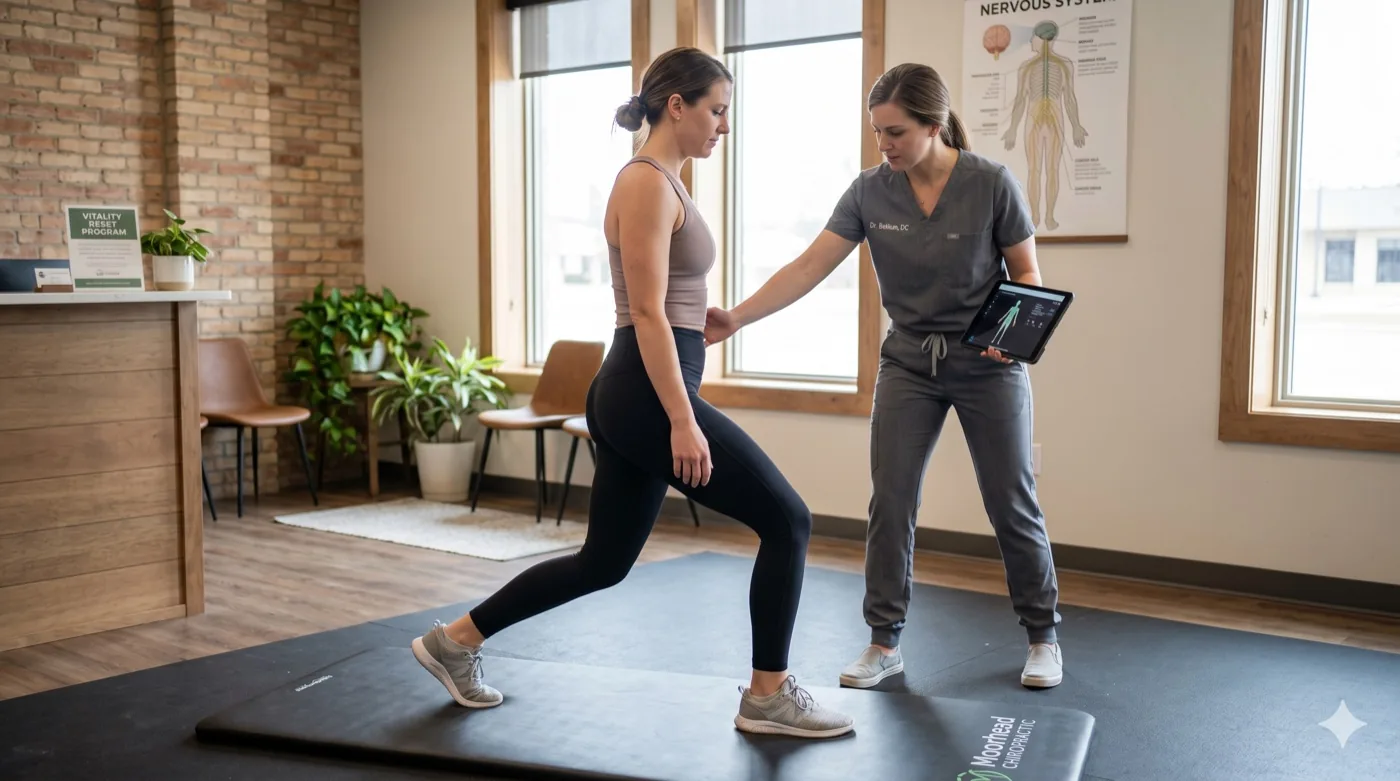
Watch Range of Motion Measured in Real Time
Kinetisense captures triplanar ROM data live — no sensors, no markers, no contact. Every degree is recorded and scored against normative benchmarks the moment the patient moves.
Visual Observation Is Not Measurement
Two experienced clinicians can watch the same patient walk and write completely different findings. That's not a skill problem — it's a data problem.
⚠ Traditional Visual Assessment
- Clinician-dependent — varies provider to provider
- No numeric output — "looks a little tight" isn't data
- No bilateral comparison — asymmetry is estimated
- Not reproducible — can't track change over time
- Can't detect subtle compensation until it becomes an injury
- No normative benchmarking for your age and activity level
✓ Kinetisense Movement Assessment
- AI-powered — same analysis regardless of who runs it
- 0–100 scored output with exact bilateral measurements
- Asymmetry index calculated in real time
- Time-stamped — track true progress over weeks and months
- Detects sub-clinical compensation patterns before they become injuries
- Every result benchmarked against age- and activity-matched norms
AI-Powered Markerless Motion Capture
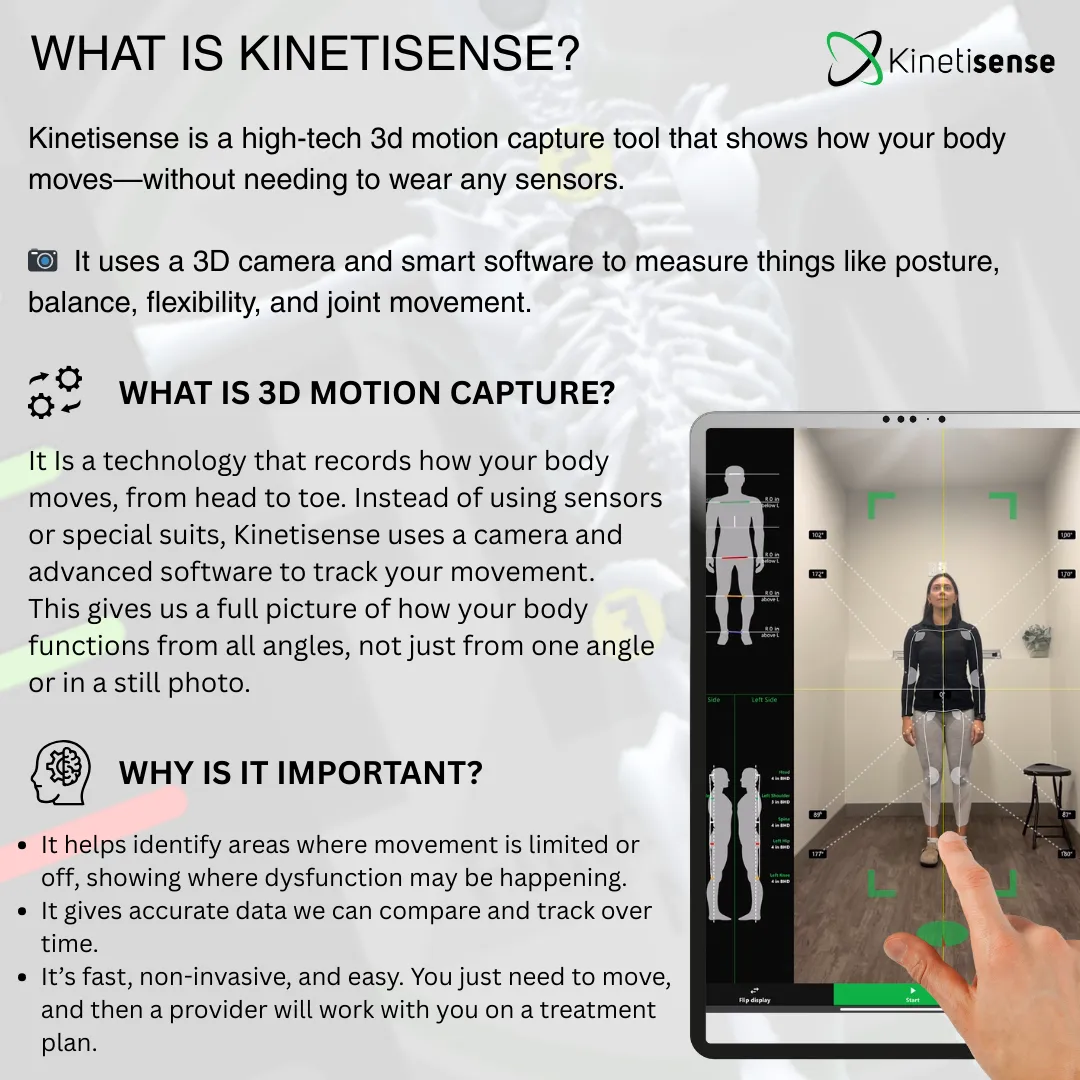
Kinetisense uses the iPad camera and computer vision to track your body landmarks in three dimensions — in real time, with no setup, no sensors, and no physical contact.
iPad Setup
The Kinetisense app opens on an iPad Pro. You stand or move in front of the camera. No sensors to attach. No markers. No calibration suit. Setup takes less than 60 seconds.
AI Tracks Your Body
Computer vision identifies and tracks dozens of body landmarks simultaneously — joints, angles, and planes of motion — in real time as you perform each assessment movement.
Data Processes Instantly
Movement data is scored against peer-reviewed normative databases. Bilateral comparisons, asymmetry indices, and range-of-motion measurements are calculated automatically.
Report Delivered Same Day
Results flow directly into your Kinetic Blueprint Report. Dr. Bekkum reviews findings with you during the same visit and maps them into your care plan that day.
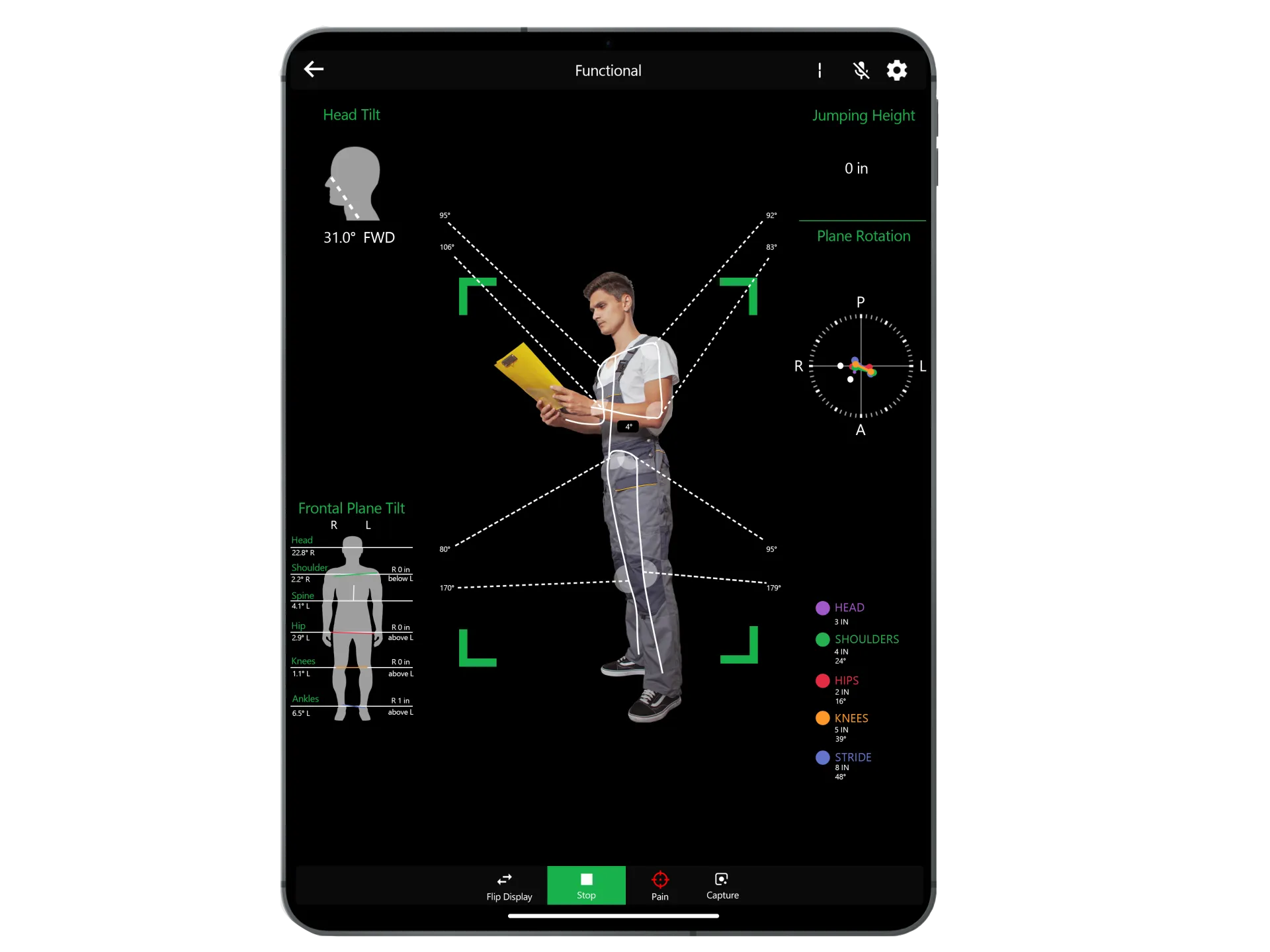
Watch Kinetisense Measure Movement in Real Time
No sensors. No markers. No wires. Markerless 3D motion capture powered by AI — running on an iPad.
The 10-Movement Clinical Workflow
KAMS is the standard assessment protocol across all three clinical contexts at Integrix Health — functional medicine intake, chiropractic documentation, and StructureIQ Performance Medicine screenings. Every movement is scored 0–100 against AMA guidelines and population norms.
Six Categories of Movement Intelligence
Kinetisense captures data across six domains — each one answering a question that physical examination alone cannot reliably answer.
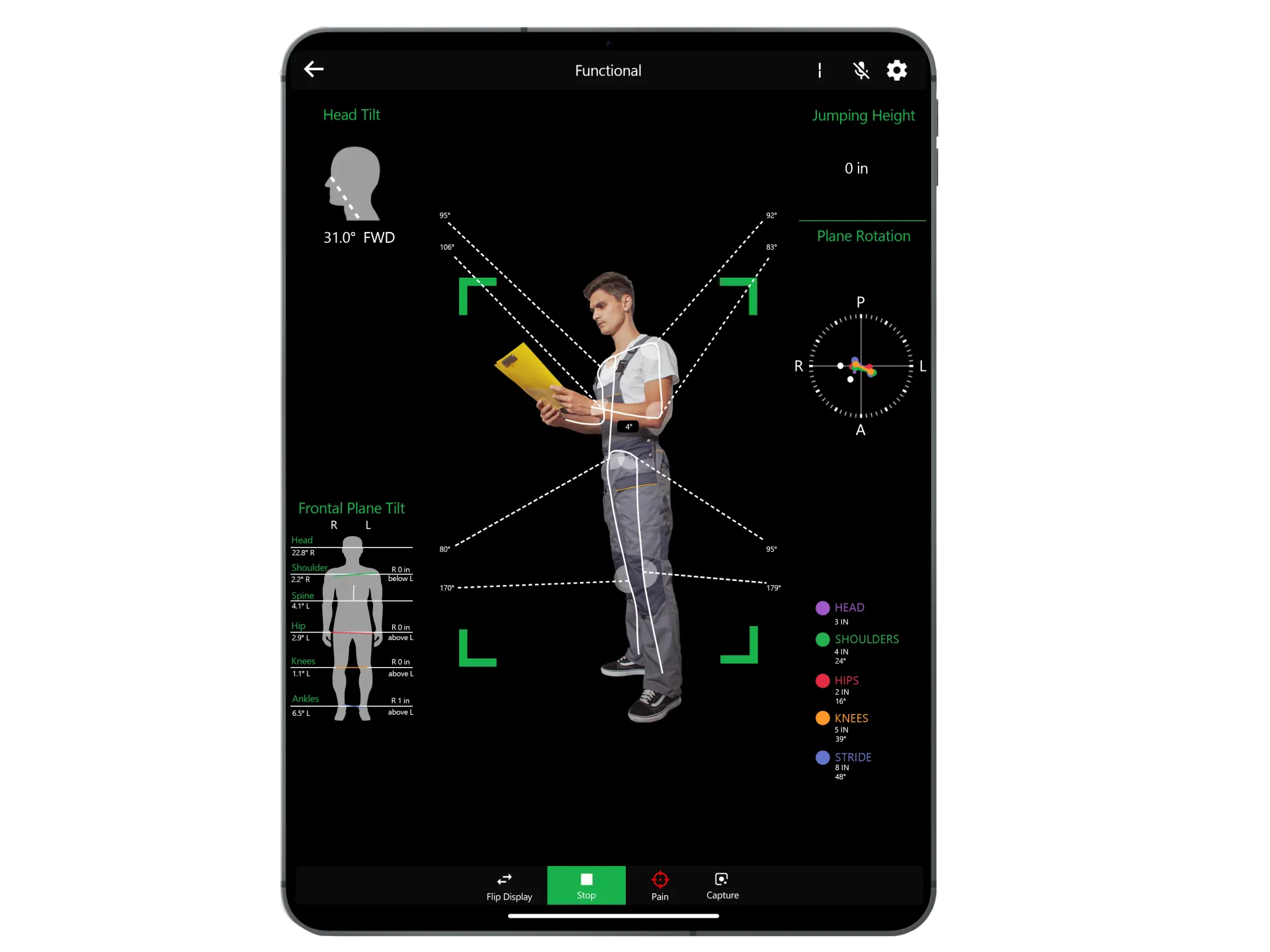
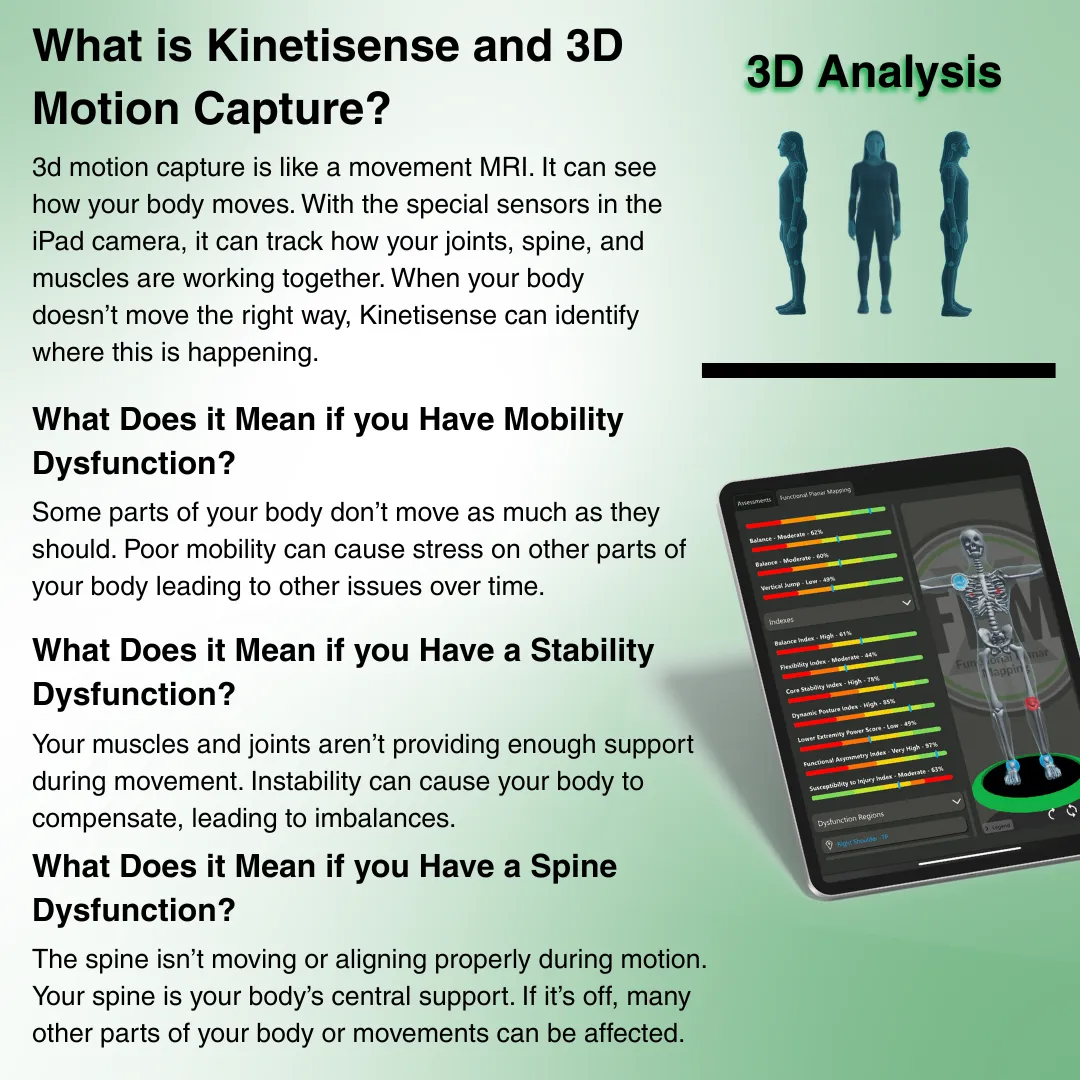
Movement Quality Score
An overall 0–100 composite score built from symmetry, range of motion, and movement pattern quality. Benchmarked to age- and activity-matched norms so your result means something specific, not just "good" or "bad."
Output: 0–100 composite scoreBilateral Asymmetry Index
Side-to-side comparison across every measured movement and joint angle. Compensatory asymmetries that develop after injury or chronic pain are detected here — often before they cause a secondary problem or re-injury.
Output: % asymmetry, left vs rightRange of Motion (AROM & PROM)
Active and passive range of motion measured in degrees at each relevant joint. Identifies mobility restrictions, hypermobility patterns, and joint segments that are loading compensatorily for a restricted neighbor.
Output: degrees bilateral, AROM + PROMBalance & Postural Control
Static and dynamic balance measured under progressively challenging conditions. Maps the neuromuscular system's ability to maintain postural control — relevant for falls risk in older adults, ankle stability in athletes, and vestibular function screening.
Output: balance score, sway velocityReaction Time
Measures the speed of the neuromuscular response to a visual or auditory stimulus. Used as a concussion baseline, cognitive-motor performance indicator, and return-to-sport threshold. Tracked in milliseconds with bilateral comparison.
Output: ms bilateral, vs age normsFunctional Movement Patterns
Sport- and activity-specific movement screens including overhead squat analysis, single-leg stance, step-down mechanics, and gait analysis. Identifies the specific movement strategies — and compensations — your nervous system has learned.
Output: scored pattern analysisActive & Passive ROM Measured in Degrees — Not Estimated
Traditional assessment relies on a clinician's visual estimate. Kinetisense measures your exact joint angles in real time using markerless motion capture — bilateral, repeatable, and benchmarked to AMA standards. The number is the finding.
Hip flexion ROM, shoulder abduction, spinal lateral flexion, and more — each captured in degrees with a left/right comparison that documents dysfunction without guesswork.
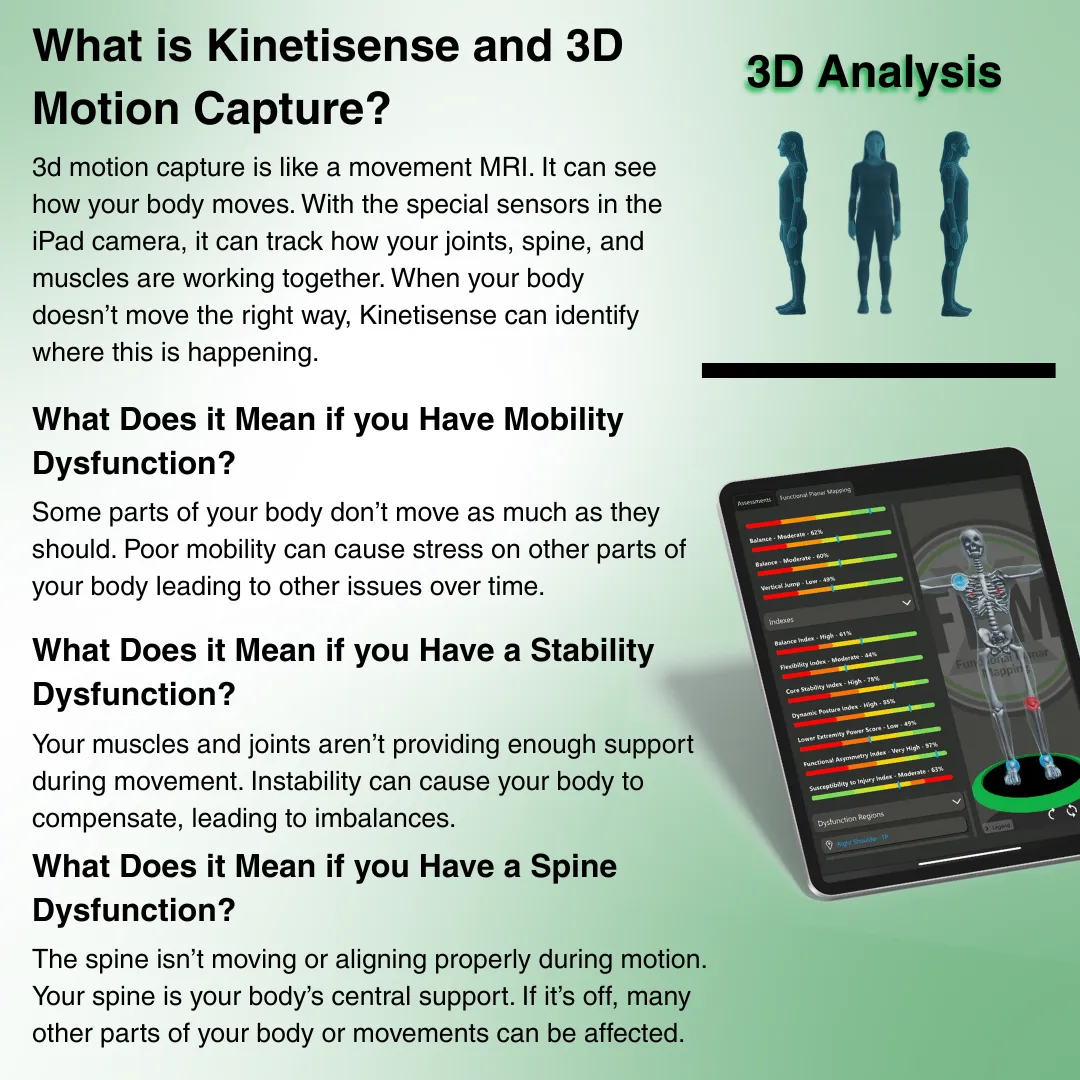
The 7 Movement Indexes — Beyond a Single Score
FPM goes deeper than an overall score. It maps each dysfunction to a specific plane of movement — transverse, sagittal, or frontal — and classifies the root as a stability deficit or a mobility deficit. That distinction changes everything about what gets prescribed next.
Movement Dysfunction as a Neurological Finding
The Neuroplanar Method® is the registered clinical methodology underlying all Kinetisense interpretation at Integrix Health. It connects what the camera captures mechanically to which neurological control system is underperforming. Poor proprioceptive feedback on single-leg balance isn’t just a balance problem — it’s a Brain-Body Axis communication breakdown with downstream implications for pain sensitization, fall risk, and chronic compensatory movement patterns.
Functional Planar Mapping — Recorded With an Actual Patient
Watch a complete Functional Planar Mapping session from intake through the 7-index output. Every movement scored in real time, stability vs. mobility classification applied automatically, and the full FPM report generated before the patient leaves the room.
Specific Screens Available with Kinetisense
Dr. Bekkum selects the relevant modules based on your presenting problem, activity level, and goals. Not every patient needs every screen — the protocol is built around your case.
Functional Movement Screen (FMS)
Seven fundamental movement patterns scored on a 0–3 scale. Identifies mobility and stability asymmetries that predict injury risk in active individuals and athletes.
Overhead Squat Analysis
Evaluates ankle mobility, hip function, thoracic extension, and shoulder mobility simultaneously. One of the highest-yield screens for identifying kinetic chain dysfunction from foot to shoulder.
Single-Leg Stance & Step-Down
Assesses dynamic stability, hip abductor control, and valgus knee patterns. Key screen for anterior knee pain, IT band syndrome, hip dysfunction, and ankle instability.
Balance Assessment (Static + Dynamic)
Tests postural control across multiple sensory conditions — vision on/off, stable/unstable surface. Clinically validated for falls risk stratification in adults 50+.
Concussion Baseline & Return-to-Play
Reaction time and balance testing establish pre-season baseline values. The same tests post-injury determine when neuromuscular function has returned to baseline — an objective threshold standard clinical observation cannot match.
Gait Analysis
Captures stride symmetry, trunk lean, hip extension, and foot progression angle during walking. Identifies gait compensations that load the lumbar spine, hip, or knee abnormally over thousands of steps per day.
Full-Body ROM Assessment
Bilateral active and passive range-of-motion measurements at cervical, thoracic, lumbar, shoulder, hip, knee, and ankle. Identifies the mobility restrictions driving your pain pattern or performance ceiling.
Re-Assessment & Progress Tracking
Time-stamped data means every follow-up assessment produces an objective before-and-after comparison. Shows you — and your referring provider — exactly how your movement has changed in response to treatment.
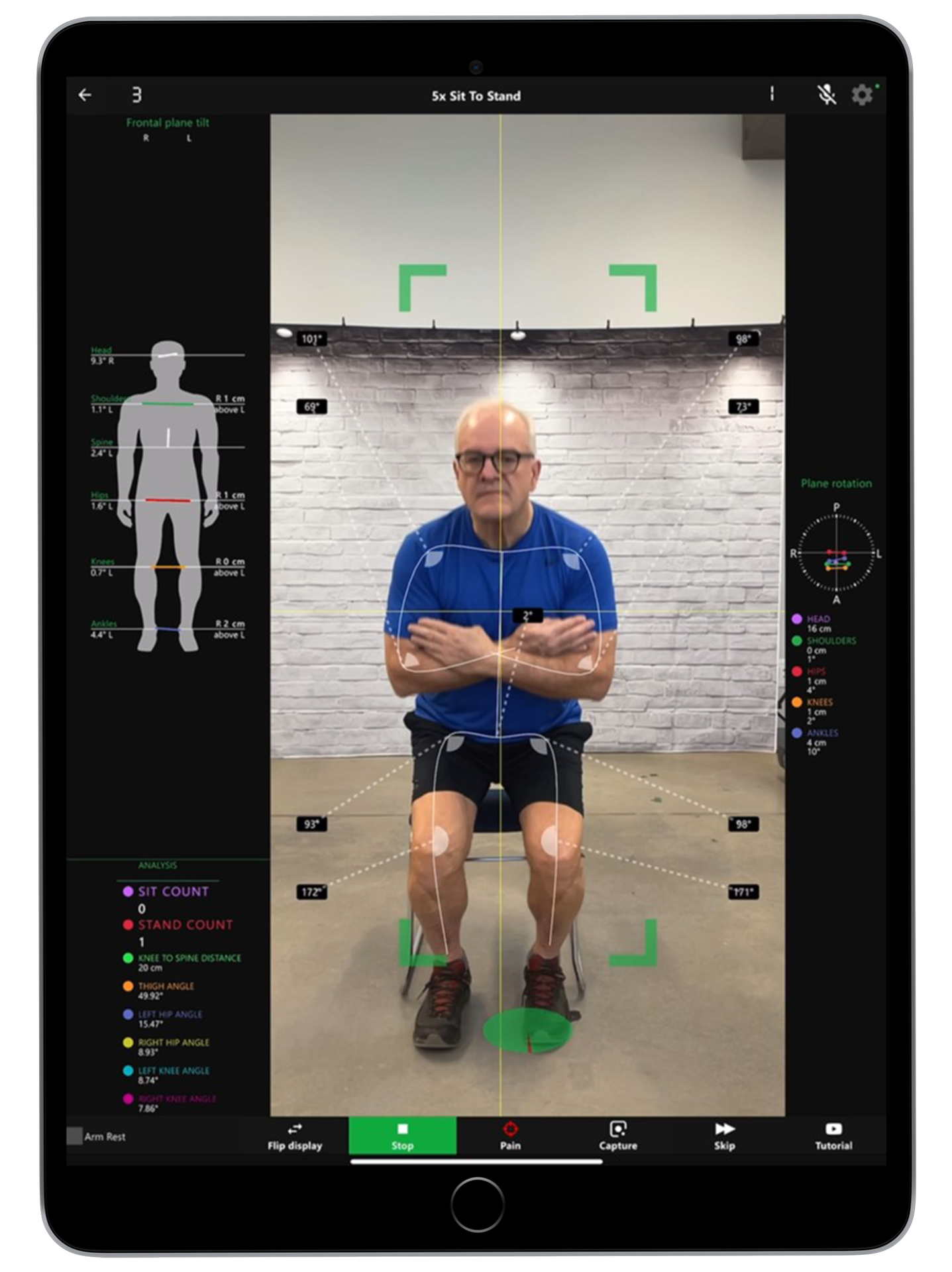
5x Sit-to-Stand — one of the standard KAMS express protocols
KAMS express protocols — auto-generated rehab plan from movement data
Illustrative only — not actual patient data
What You Get From the Kinetisense Assessment
The Kinetisense output isn't a printout to file away. Every number maps to a clinical decision. A hip ROM asymmetry of 19% tells Dr. Bekkum exactly where to look in the kinetic chain. A balance score in the 40th percentile for your age changes the rehab protocol immediately.
Results are reviewed with you during your visit — not mailed two weeks later. By the time you leave, you'll understand what your numbers mean and how they connect to your symptoms, your performance, or your risk.
- KAMS composite score (0–100) with scoring category — Very Poor | Poor | Moderate | Good
- Functional Planar Mapping (FPM) — all 7 Movement Indexes with stability vs. mobility classification
- Bilateral ROM measurements in degrees at all major joints (AMA-percentage scored)
- Functional Asymmetry Index — left-right percentage differences across 6 movements
- Susceptibility to Injury Index (inversely scored — higher percentage = greater risk)
- Balance Index with Brain-Body Axis proprioceptive interpretation
- Clinical review from Dr. Bekkum at time of visit — integrated into your Kinetic Blueprint Report
Movement Data That Drives the Care Plan
Kinetisense is part of every StructureIQ Kinetic Blueprint Report — the 30-minute baseline assessment that precedes any structural or rehabilitative care at Integrix Health. Before a single adjustment or rehab exercise is prescribed, the data is in the room.
The movement score alone doesn't tell the whole story. It's what happens when you review the full Kinetisense data — every metric tells part of the story. Together, they reveal the full compensation pattern.
For chronic pain patients, the asymmetry data often explains why previous treatment only worked temporarily. Correcting what you can see without correcting the underlying asymmetry is treating a symptom, not a cause.
Re-assessments are scheduled at 6–8 week intervals during active care. The time-stamped comparison shows objective progress — or reveals that the current approach needs to change.
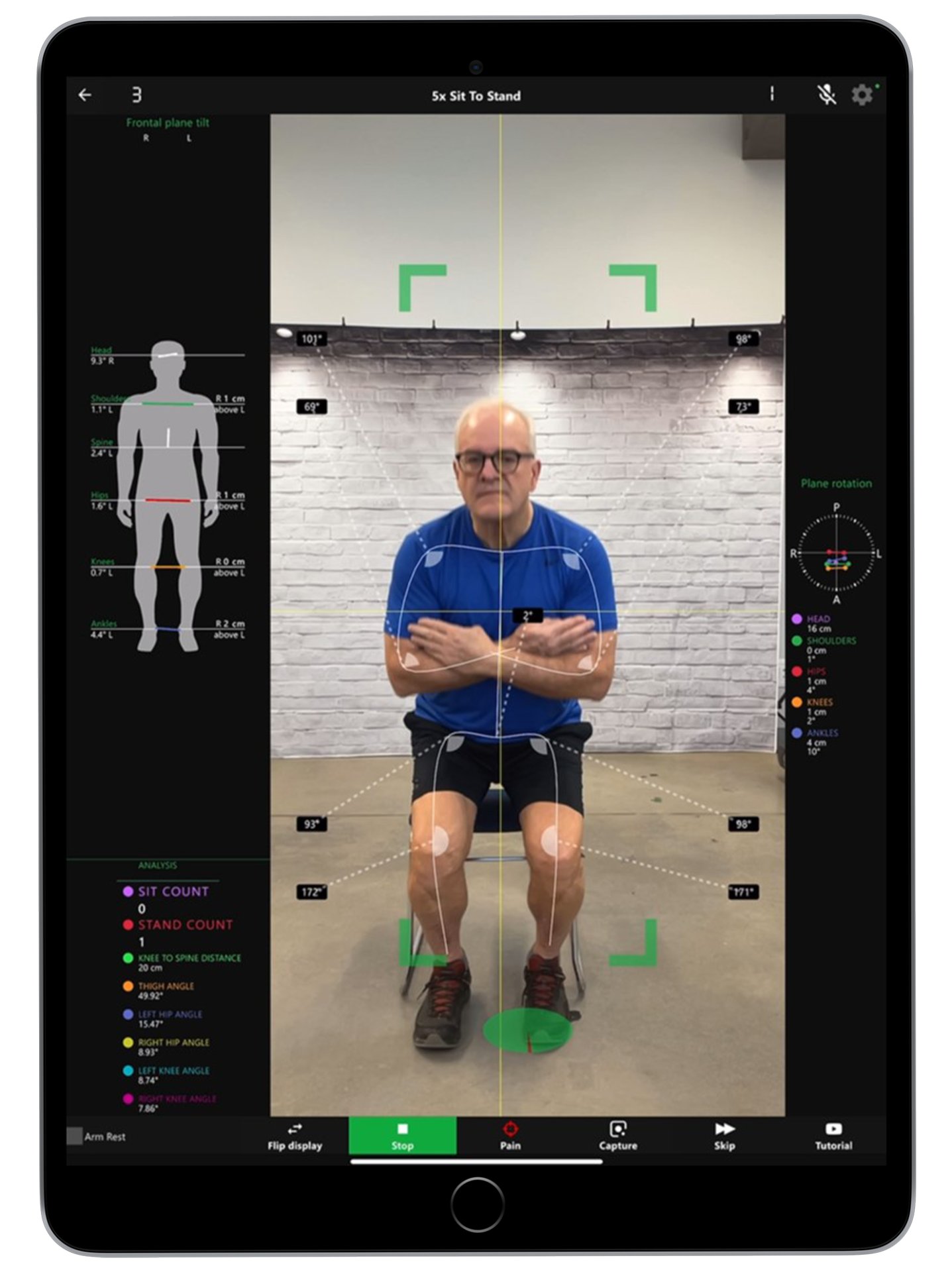
Kinetic Blueprint Report Intake — Kinetisense Screens
Movement quality, ROM, balance, asymmetry, and reaction time captured during the 30-minute Kinetic Blueprint Assessment.
Cross-Reference with Foot Structure Data
Kinetisense movement data is cross-referenced with your foot structure findings to identify the full kinetic chain driver of your movement dysfunction.
Protocol Built From Data
Rehab exercises, chiropractic adjustments, and movement correction protocols are selected based on objective findings — not symptom location alone.
Reassess — Objective Before-and-After
Kinetisense re-assessment at defined intervals closes the Assess–Correct–Reassess loop with time-stamped comparison data. Quantified improvement percentages go into the SOAP note — progress is measured, not assumed.
The Kinetisense Assessment Is Right For You If…
🏋️ Athletes & Active Performers
You train hard and want objective injury-risk data before something breaks. Or you've been dealing with a nagging issue that's limiting performance and previous assessments haven't identified the root cause. The movement quality score and asymmetry index give you a specific target to address — not a vague recommendation to "strengthen your core."
🔥 Chronic Pain Patients
Pain has limited your movement and you've compensated — you just don't know how or where yet. Kinetisense often reveals the compensation pattern that developed after an old injury or surgery, which is now loading the wrong structures and keeping you in the pain cycle. Seeing the asymmetry data changes the conversation entirely.
🧓 Adults Concerned About Balance & Falls
Balance decline begins in the 50s and is largely invisible until a fall happens. The Kinetisense balance assessment gives you an objective number — ranked against your age group — and identifies whether the deficit is vestibular, neuromuscular, or proprioceptive. That distinction determines the correct intervention.
🏥 Post-Surgical Return to Activity
After a hip replacement, ACL repair, or spinal surgery, the question isn't just "does it hurt?" — it's "is the movement pattern safe?" Kinetisense re-assessment provides an objective return-to-activity threshold: bilateral symmetry, ROM, and movement quality back within acceptable range, not just pain-free range of motion.
Frequently Asked Questions
Kinetisense measures movement quality score (0–100), bilateral asymmetry index, static and dynamic balance, active and passive range of motion at all major joints, reaction time, and specific functional movement patterns including overhead squat, single-leg stance, gait, and step-down mechanics. Each result is benchmarked against age- and activity-matched normative data.
A standard movement exam depends entirely on the clinician's visual observation and judgment — which varies between providers and produces no reproducible data. Kinetisense uses AI-powered markerless motion capture to generate scored, time-stamped, objective measurements that can be compared to normative values and tracked precisely over time, independent of who performs the assessment.
No. Kinetisense is fully markerless — it uses the iPad camera and computer vision to track your body landmarks in real time. You don't wear anything, have anything attached, or need to change clothes. Setup takes under 60 seconds.
Yes. Kinetisense is performed at Integrix Health at 22 6th St N Suite 8 in Moorhead MN — less than 10 minutes from downtown Fargo and West Fargo. It is included as part of the StructureIQ Kinetic Blueprint Report Assessment. Call 701-347-1968 or book online at integrix.health.
The Kinetisense portion of the Kinetic Blueprint Assessment typically takes 15–25 minutes depending on which modules are selected. The complete Kinetic Blueprint Report — which includes Kinetisense and Footmaxx AcquireTD 3D foot scanning — is 30 minutes total.
Get Your Movement Scored.
Not Estimated.
The Kinetisense assessment is part of every StructureIQ Kinetic Blueprint Report. 30 minutes. Six categories of objective data. Same-day results. Moorhead MN — serving Fargo, West Fargo, and the Fargo-Moorhead metro.
Integrix Health · 22 6th St N Suite 8, Moorhead MN 56560 · 701-347-1968